

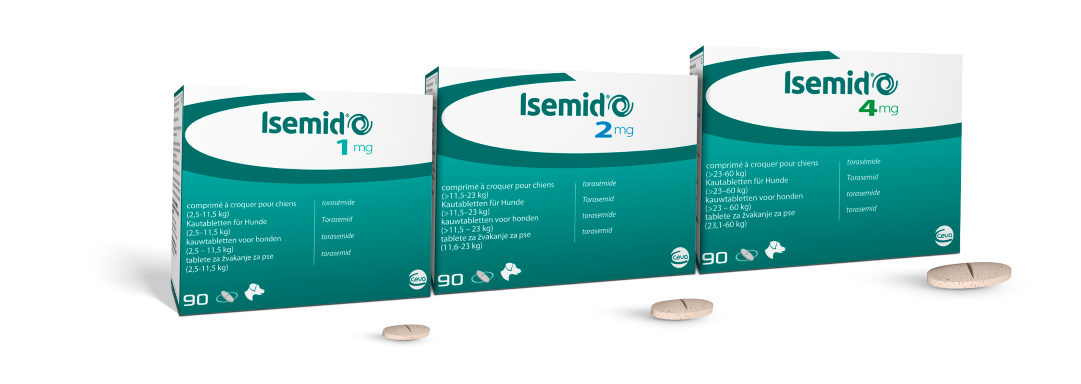

The product is recommended for the treatment of clinical signs, including pulmonary edema, associated with congestive heart failure in dogs.
Ingredients:
Active substance: 1 mg, 2 mg ,4 mg torasemide;
Excipients: Lactose monohydrate; Microcrystalline cellulose; Povidone (K30); Pork liver powder flavor; Compressible sugar; Crospovidone (type B).
Key benefits:
Effective in the treatment of clinical signs associated with congestive heart failure in dogs.
In dogs presenting with acute pulmonary edema requiring emergency treatment, the use of injectable medications should be considered initially before initiating oral diuretic therapy.
The diuretic response to torasemide may increase over time after repeated administration, particularly at doses higher than 0.2 mg/kg/day. Therefore, more frequent monitoring should be considered.
In a clinical study, Isemid has demonstrated efficacy when used as first-line treatment. As the substitution of an alternative loop diuretic with this veterinary medicinal product was not evaluated in this study, such a change should only be implemented based on a benefit-risk assessment by the responsible veterinarian.
Intended use:
Isemid 1 mg for dogs between 2.5 – 11.5 kg
Isemid 2 mg for dogs between 11.5 – 23 kg
Isemid 4 mg for dogs between 23 – 60 kg
Method of administration:
Oral.
The tablets can be administered directly to the dog or in a piece of food.
No dietary measures (fasting) are required before or after treatment.
Presentation:
Blister/Blister of 10 tablets.
Dosage:
The recommended initial/maintenance dose is 0.13 to 0.25 mg torasemide/kg body weight/day, once daily.
In case of moderate or severe pulmonary edema, this dose may be increased if necessary up to a maximum dose of 0.4 mg/kg body weight/day, once daily.
Doses of 0.26 mg/kg and above should be administered for a maximum period of 5 days. After this period, the dose should be reduced to the maintenance dose and the dog should be evaluated by a veterinarian within a few days.
The following table shows the dose adjustment schedule within the recommended dose range of 0.13 to 0.4 mg/kg/day:
Weight of dog (kg) Number and strength of Isemid tablets to be administered
Initial/maintenance dose
(0.13 to 0.25 mg/kg/day) Temporary increased dose
(0.26 to 0.40 mg/kg/day)
1 mg
2.5 to 4 ½ 1
>4 to 6 1 1 + ½
>6 to 8 Between 1 and 1 + ½ Between 2 and 2 + ½
>8 to 11.5 Between 1 + ½ and 2 Between 2 + ½ and 3
2 mg
>11.5 to 15 Between 1 and 1 + ½ 2
>15 to 23 Between 1 + ½ and 2 Between 2 + ½ and 3
4 mg
>23 to 30 Between 1 and 1 + ½ 2
>30 to 40 Between 1 + ½ and 2 Between 2 + ½ and 3
>40 to 60 Between 2 and 2 + ½ Between 3 and 4
The dose should be adjusted to maintain the patient’s comfort, paying attention to renal function and electrolyte status.
Once signs of congestive heart failure have been controlled and the patient is stable, the lowest dose should be continued if long-term therapy with this drug is necessary.
Possible adverse effects:
In a clinical study, the following adverse effects were observed very commonly: renal failure, an increase in renal blood parameters, hemoconcentration and changes in electrolyte levels (chloride, sodium, potassium, phosphorus, magnesium, calcium).
The following clinical signs were commonly observed: transient gastrointestinal symptoms such as vomiting and diarrhoea, dehydration, polyuria, polydipsia, urinary incontinence, anorexia, weight loss and lethargy.
Other effects associated with the pharmacological activity of torasemide were observed in preclinical studies in healthy dogs at the recommended dose, such as: dryness of the oral mucosa, reversible increases in serum glucose and aldosterone concentrations, decreased urine specific gravity and increased urine pH.
If you notice any serious reactions or other effects not mentioned in the package leaflet, please inform your veterinarian.
Precautions:
Do not use in case of renal insufficiency.
Do not use in case of severe dehydration, hypovolaemia or arterial hypotension.
Do not use concomitantly with other loop diuretics.
Do not use in case of hypersensitivity to the active substance or to any of the excipients.
The safety and efficacy of the product have not been evaluated in dogs weighing less than 2.5 kg. In these animals, use only based on a benefit-risk assessment by the responsible veterinarian.
Torasemide should be used with caution in cases of diabetes mellitus. Monitoring of blood glucose levels in diabetic animals is recommended before and during treatment. In dogs with pre-existing electrolyte and/or water imbalance, this should be corrected before treatment with torasemide. As torasemide increases thirst, dogs should have free access to fresh water.
In case of loss of appetite and/or vomiting and/or lethargy or in case of adjustment of treatment, renal function (blood urea and creatinine, as well as urinary protein:creatinine ratio (UPC)) should be assessed.
Storage:
Store away from moisture and direct sunlight, at temperatures up to 25°C.
In case of overdose:
After administration to healthy dogs of 3 times and 5 times the maximum dose for 5 consecutive days, followed by 177 daily administrations of 3 times and 5 times the highest recommended maintenance dose, histopathological changes in the kidneys (interstitial inflammation, renal tubular dilation and subcapsular cysts) were noted in addition to the effects observed after administration of the recommended dose.
Renal lesions were still present 28 days after the end of treatment.
Microscopic features of the lesions suggest a ongoing repair process.
These lesions can most likely be considered as a consequence of the pharmacodynamic effect (diuresis) and were not associated with evidence of glomerulosclerosis or interstitial fibrosis.
Transient dose-related changes in the adrenal glands, consisting of minimal to moderate reactive hypertrophy/hyperplasia, probably related to increased aldosterone production, were observed in dogs treated with up to 5 times the recommended therapeutic dose.
An increase in plasma albumin concentration was observed.
ECG changes without clinical signs (increased P-value and/or QT interval) were observed in some animals after administration of 5 times the recommended dose.
A causal role of changes in plasma electrolyte values cannot be excluded.
After administration of 3 and 5 times the recommended therapeutic dose in healthy dogs, a decrease in appetite was observed, which resulted in weight loss in some cases.
In case of overdose, please contact your veterinarian immediately.


Reviews
There are no reviews yet.